

The Nokta Legend 2: What's Actually Different — And What Real Detectorists Are Saying
Published by Justin Underwood on 02/27/26

When the original Nokta Legend hit the market, it didn't just compete — it disrupted. Here was a simultaneous multi-frequency detector that, in independent testing, matched signals with machines costing two and three times as much. It earned a fiercely loyal following, and for good reason.
So when Nokta announced the Legend 2, the detecting community wanted a straight answer: is this a real upgrade, or a fresh coat of paint.
After digging into the specs, reading every review we could find, watching the field tests, and combing through forum discussions from detectorists who've already put the Legend 2 in the dirt — we can tell you this is not a cosmetic refresh. It's a ground-up rework of the hardware, software, and ergonomics that made the original great.
But we're not here to just make claims. We're going to break down every upgrade, explain what it actually means when you're swinging over a trashy colonial site or working a saltwater beach, and share what real users are reporting from the field — the good and the not-so-good.
Let's also address the elephant in the room: at $999, the Legend 2 is a notable jump from what many Nokta users are accustomed to paying. If you've been in the Nokta ecosystem buying Simplex+ units and original Legends in the $500–$750 range, that number might sting a little. Stick with us through this breakdown, because by the time you see what you're getting — and what comparable machines from other brands cost — the picture becomes very clear.
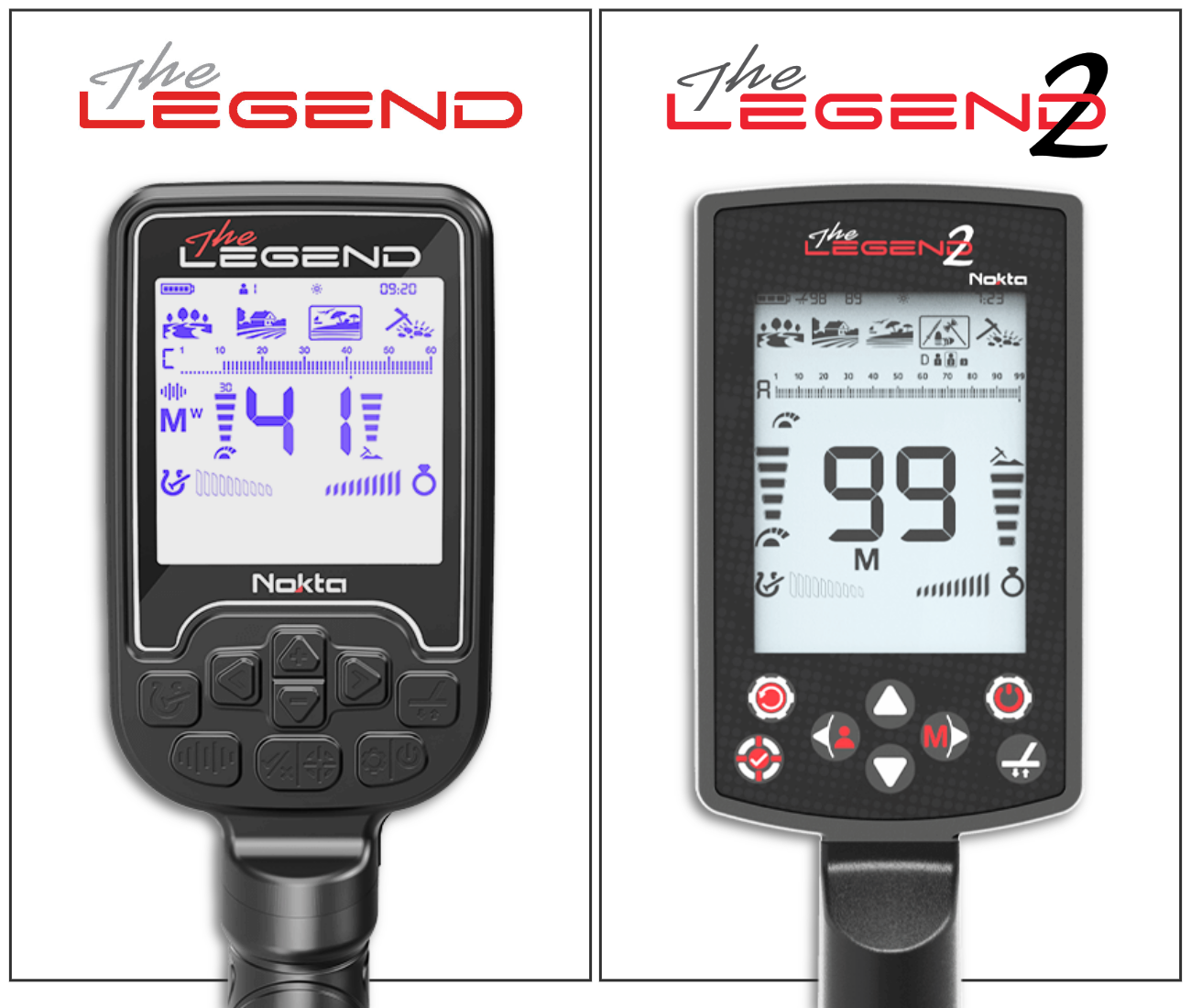
What Stayed the Same (And Why That Matters)
Before we talk about what's new, it's worth noting what Nokta didn't change — because it tells you a lot about their approach. They kept the foundation that the community already trusts and built on top of it.
Simultaneous Multi-Frequency Technology (SMF) — Both the Legend and Legend 2 transmit multiple frequencies at once for maximum depth, sensitivity, and stability across different ground conditions. This is the same proven SMF platform that had detectorists comparing the original Legend to machines at double and triple the price.
Single Frequency Options — Same five individual frequencies: 4, 10, 15, 20, and 40 kHz. Run multi-frequency for general hunting or switch to single for specialized conditions.
IP68 Waterproof to 5 Meters (16 ft) — Fully submersible. Rain, shallow rivers, surf — neither detector will flinch.
Core Search Modes — Park, Field, Beach, and Gold modes carry over. If you know the original Legend, the Legend 2 will feel like home.
Nokta didn't break what was already working. They identified what the community was asking for and delivered targeted improvements where they matter most.
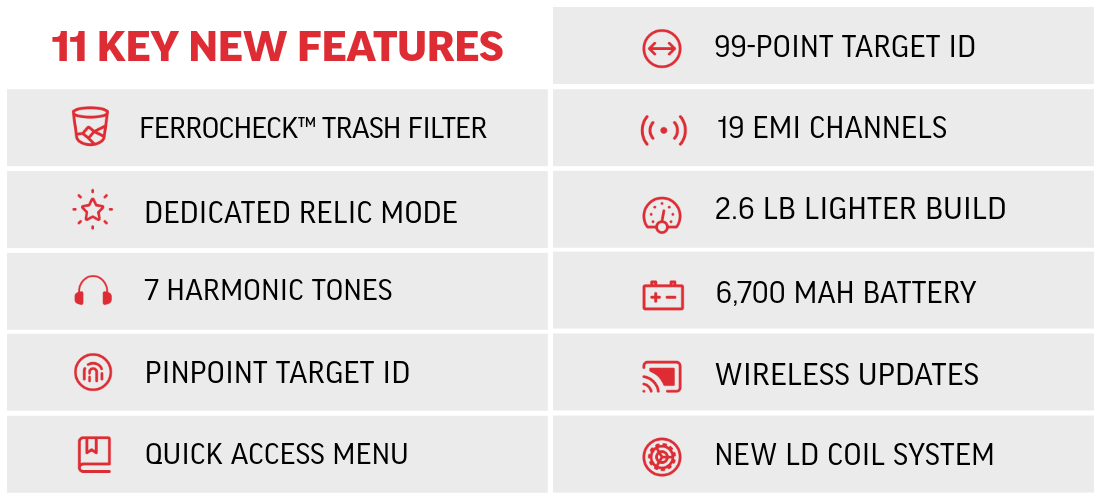
What Changed: Every Upgrade Explained
Here's the meat of it. For each improvement, we'll tell you what's different and why it matters out in the field.
Expanded 99-Point Target ID (Up from 60)
The original Legend used a 0–60 Target ID scale. The Legend 2 expands this to 0–99. That's not just a bigger number on the screen — it fundamentally changes how much information you have before you decide to dig.
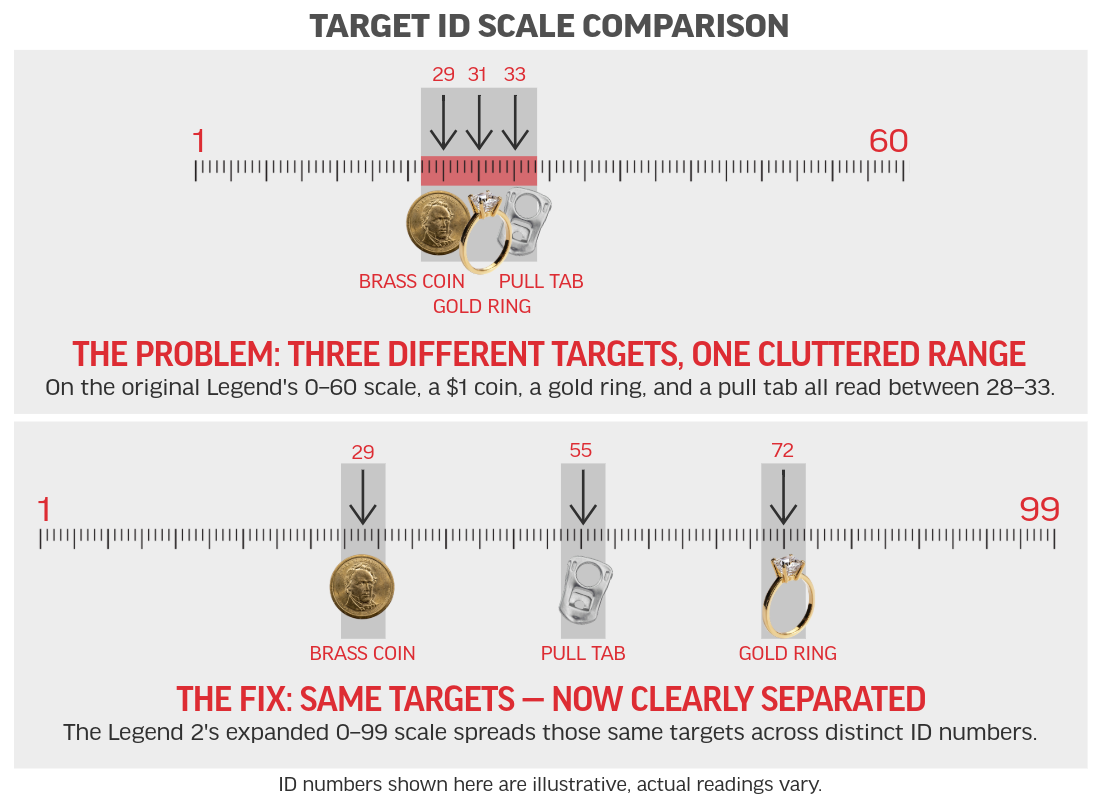
With 60 IDs, multiple target types can cluster around the same numbers. A thin gold ring, a pull tab, and a small brass button might all read within a point or two of each other. With 99 IDs, those targets spread out. You get more space between them, more granularity, more information to work with. At an old homestead where coins sit inches from square nails, or at a beach where gold hides among aluminum trash, that extra resolution is the difference between confident digs and coin flips.
Early user reports consistently note that in trashy parks and iron-heavy sites, the expanded ID range paired with the Legend 2's additional EMI channels produces noticeably cleaner discrimination — fewer wasted digs on junk, fewer good targets slipping through.
This was one of the original Legend's most commonly cited limitations. Nokta clearly listened.
FerroCheck™ Trash Filter
This is brand new — the original Legend did not have it. FerroCheck adds a dedicated on-screen meter that shows you the ferrous vs. non-ferrous character of a signal in real time.
Picture this: you get a solid mid-tone signal, the ID number looks promising, and you're reaching for your digger. With FerroCheck, you glance at the meter and see it's pegged toward the ferrous side. That corroded nail or misshapen bottle cap just tried to fool your ears, and the meter caught it. You move on. Over a full day of hunting, that adds up to dozens of holes you didn't waste your time digging — and more energy spent on actual targets.
One UK-based field tester specifically noted in his review that he repeatedly encountered sweet-sounding signals where the FerroCheck meter "was clearly saying no" — saving him from targets that would have fooled his ears alone. If you've ever dug 30 bottle caps in a day, you already understand the value here.
Dedicated Relic Mode (Replaces Beast Mode)
The original Legend's "Beast Mode" was a deep-seeking powerhouse, but it was broad — designed for fringe-depth detection in general. The Legend 2 replaces it with a purpose-built Relic Mode tuned specifically for irregular metal shapes and the deeper, fainter signals you get from historical artifacts.
Buttons, buckles, musket balls, colonial-era coins buried among iron trash — these are targets that sit in the ground differently than modern coins. They oxidize differently, they conduct differently, and they're almost always surrounded by iron junk from the same era. Relic Mode is optimized for exactly these conditions. It's a ready-to-go program that doesn't require you to spend an hour dialing in custom settings before a hunt at a permission site.
For the relic hunters in the Kellyco community — and there are a lot of you — this is one of the most meaningful additions in the entire Legend 2 package.
Redesigned Audio System with 7 Harmonic Tones
Experienced detectorists hunt by ear as much as by screen. The Legend 2 features a completely reworked audio engine with 7 customizable harmonic tones and adjustable frequencies. The original Legend used a different architecture with 60 tones.
The practical difference is nuance. Harmonic tones give you richer, more natural audio that's easier on the ears during long sessions. The ability to fine-tune frequency response for each tone zone means you can set your audio to match your hearing — which matters more than most people realize, especially for detectorists who've been at this for years and may have some hearing loss in specific frequency ranges.
Multiple independent reviewers have called the audio upgrade alone a strong reason to choose the Legend 2. If you're someone who trusts your ears more than the screen, this one's for you.
Target ID Visible in Pinpoint Mode
On the original Legend, when you entered pinpoint mode, the Target ID disappeared from the screen. Gone. You were narrowing down a target's position blind to what it actually was.
The Legend 2 keeps the Target ID visible throughout pinpointing. It sounds simple because it is — but in a trashy area where multiple targets sit within inches of each other, being able to confirm the ID while you're zeroing in on location means faster, more confident recovery. This was one of the original Legend's most-discussed shortcomings in the community, and it's fixed.
Quick Access Menu
Press the up/down arrow keys on the Legend 2 and you instantly access five critical settings: Sensitivity, Frequency, Discrimination, Recovery Speed, and Bottle Cap Reject/Stabilizer.
The original Legend required scrolling through menus to adjust these on the fly. In the field, conditions change constantly — you walk from clean pasture to an iron-heavy fence line, the ground moisture shifts, you suddenly have EMI from a nearby detector. Being able to adjust key settings in seconds instead of stopping your hunt to navigate menus is a real quality-of-life improvement.
One experienced reviewer called this "a lifesaver," and after using the original Legend's menu system, it's easy to see why.
New LD Coil Ecosystem
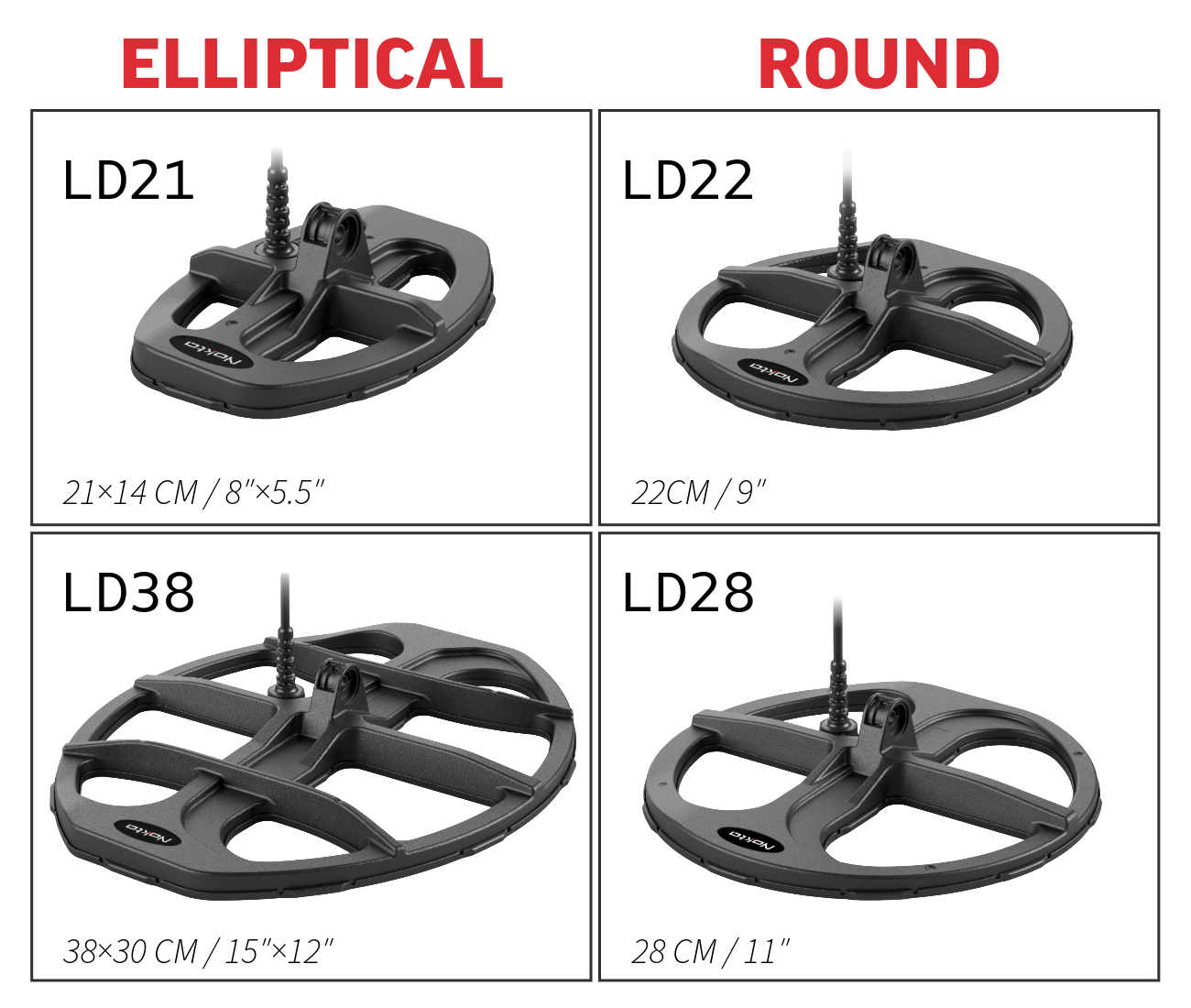
The Legend 2 introduces a new LD-series coil platform, replacing the original's LG-series coils. It ships with two coils right in the box: the LD28 (11" DD) for general purpose work and open ground coverage, and the LD21 (8" x 5.5" DD) for tight spots and target-dense trashy areas. Additional coils include the LD22 (9" DD) and LD38 (15" x 12" DD).
Getting two coils included at this price is a big deal — with other brands you're typically buying your second coil separately for $150–$300 on top of the detector price.
One important note for current Legend owners: The LD-series and LG-series coils are not cross-compatible. If you're upgrading and have a collection of LG coils, they won't work on the Legend 2. Worth factoring into your decision.
19 EMI Frequency Shift Channels (Up from 13)
Electromagnetic interference — from power lines, cell towers, underground utilities, other detectors nearby — destabilizes your signals and produces false readings. The original Legend offered 13 channels to work around EMI. The Legend 2 bumps that to 19.
More channels mean more options to find clean, stable frequencies, especially in urban parks and populated areas where EMI is worst. If you've ever hunted near a power line and watched your original Legend chatter with false signals no matter what you tried, those six extra channels give you significantly more room to find quiet ground.
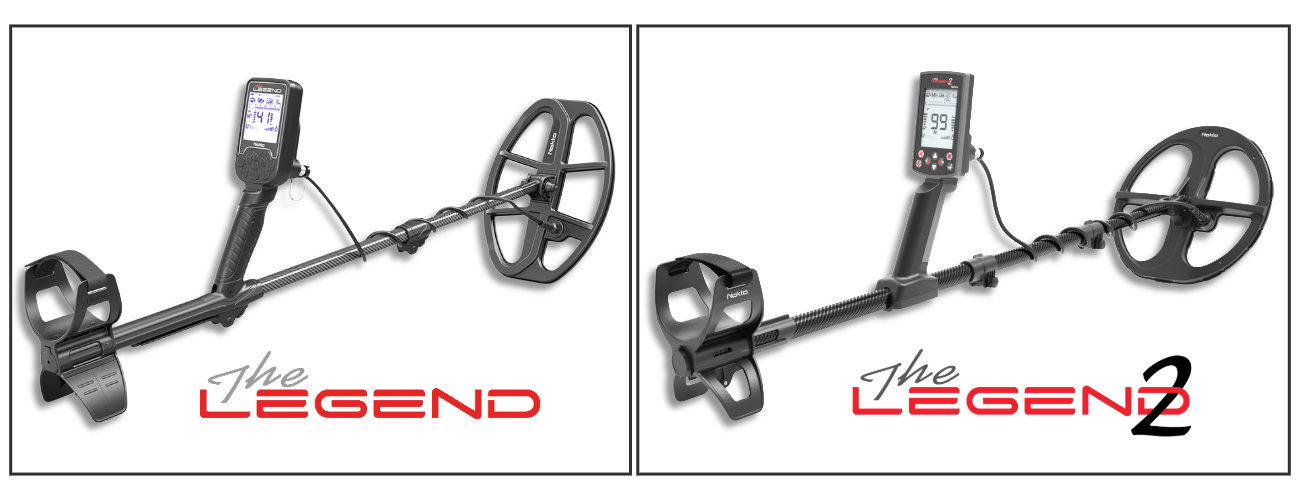
Lighter Build: 2.6 lbs (Down from ~3.0 lbs)
Half a pound doesn't sound like much at 8 AM. By 2 PM, your arm knows the difference. The Legend 2 drops to 1.2 kg (2.6 lbs) with a carbon fiber shaft and fold-flat coil design. The shaft collapses to just 25 inches (63 cm) — tosses right in the back seat.
The improved balance and lighter feel aren't just about raw weight, either. How a detector distributes that weight matters for swing fatigue, and the Legend 2's redesigned ergonomics with an adjustable armrest make all-day sessions noticeably more comfortable.
Bigger Battery: 6,700 mAh (Up from 5,050 mAh)
The Legend 2 packs a 6,700 mAh lithium-ion battery — a 33% increase over the original's 5,050 mAh lithium polymer unit. If you're the type who heads out at dawn and doesn't come back until dinner, or if you're on a multi-day trip where outlets are scarce, the longer runtime speaks for itself. Nobody wants a dead battery at the best spot of the day.
Wireless Firmware Updates
The original Legend required a wired USB connection to a computer for firmware updates. The Legend 2 supports wireless updates directly from your smartphone via Bluetooth.
This matters more than it seems at first glance, because Nokta has a strong track record of rolling out updates that meaningfully improve performance after launch. The original Legend received multiple updates — including Beast Mode, Bottle Cap Rejection, Ground Suppressor, Iron Filter improvements, and pinpoint refinements — that made it a noticeably better detector over time. The Legend 2 is built to continue that trajectory, and wireless updates remove the friction of keeping current. When Nokta pushes an improvement, you can have it loaded before your next hunt without hunting down a laptop and USB cable.
Legend vs. Legend 2: Side-by-Side Comparison
|
Feature |
Nokta Legend |
Nokta Legend 2 |
|---|---|---|
|
Technology |
Simultaneous Multi-Frequency (SMF) |
Simultaneous Multi-Frequency (SMF) |
|
Single Frequencies |
4, 10, 15, 20, 40 kHz |
4, 10, 15, 20, 40 kHz |
|
Search Modes |
Park, Field, Beach, Gold, Beast |
Park, Field, Beach, Gold, Relic |
|
Target ID Range |
0–60 |
0–99 |
|
FerroCheck™ |
❌ |
✅ |
|
Target ID in Pinpoint |
❌ |
✅ |
|
EMI Frequency Shift Channels |
13 |
19 |
|
Audio System |
60 tones |
7 harmonic tones + adjustable frequencies |
|
Quick Access Menu |
❌ |
✅ |
|
Battery |
5,050 mAh (Li-Polymer) |
6,700 mAh (Li-Ion), ~33% longer runtime |
|
Weight |
~3.0 lbs (1.3 kg) |
~2.6 lbs (1.2 kg) |
|
Keypad Backlight |
❌ |
✅ |
|
Backlight Auto Mode |
❌ |
✅ |
|
Wireless Firmware Updates |
❌ |
✅ (Bluetooth) |
|
Bone Conduction Headphone Support |
❌ |
✅ |
|
Charge LED Indicator |
❌ |
✅ |
|
Coil Series |
LG Series |
LD Series (not cross-compatible) |
|
Waterproof Rating |
IP68 – 5m (16 ft) |
IP68 – 5m (16 ft) |
|
Included Coils |
Varies by package |
Two: LD28 (11") + LD21 (8" x 5.5") |
|
Included Headphones |
Varies by package |
Bluetooth aptX Low Latency |
|
User Profiles |
4 per mode (4 modes) |
3 per mode + factory default (5 modes) |
What Real Users Are Saying
Specs tell one story. Dirt tells another. Here's what independent reviewers and community members are reporting after putting the Legend 2 through actual field conditions — including the things they wish were different.
Skill School (UK Field Tester & YouTube Reviewer)
Gary Blackwell at Skill School put the Legend 2 through real UK field conditions — wet pasture, plowed fields, the kind of ground that tests a detector's stability.
What stood out: Stability was the headline for him. He found the Legend 2 could run the higher M2 multi-frequency setting on wet ground where the original Legend typically required switching to beach mode. For UK detectorists hunting wet pasture for hammered and Roman coins, that's a meaningful gain. He described the FerroCheck meter as "a valuable asset," noting that misshapen iron can fool any detector — but the meter repeatedly flagged false signals that sounded clean to the ear. He also called the quick access menu "a lifesaver" for cutting through menu navigation time.
Field results: Running the field program with 3 tones, iron volume at 10, and tone break at 60, he found high-conductive coin signals came through sharp and unmistakable every time. He did note that sensitivity was easy to overcook — settling on 20 as a good compromise.
His take: He came away "suitably impressed" and noted the Legend 2 retains the same sharp signal characteristics of the original while adding meaningful stability and usability improvements.
Mental Metal Detecting (In-Depth Comparison Review)
Scott at Mental Metal Detecting published a detailed head-to-head comparison of the Legend vs. Legend 2, pulling from early tester reports and community feedback.
What stood out: He noted the Legend 2 holds a more stable ID in difficult soils and black sand compared to the original. In trashy parks, the expanded ID range and extra EMI channels combine to produce noticeably cleaner discrimination — fewer wasted digs and fewer good targets getting masked.
On the original Legend's weaknesses: He was candid that the original, despite its impressive capability, suffered from an overcomplicated menu system. The Legend 2's redesigned interface and quick access menu address this head-on.
His take on the upgrade question: He acknowledged that the Legend 2 represents clear forward progress in performance, convenience, and user experience — but was honest that the original launch timeline was delayed due to hardware issues, raising the question of whether Nokta got everything right this time around. He concluded with a measured "only time will tell" — a fair take that reflects how many in the community are approaching this release.
iRate Metal Detectors (NYC Field Tester — Original Legend Context)
The iRate Metal Detectors reviewer in New York City is known for rigorous, data-driven testing. His extensive review of the original Legend provides critical context for understanding the Legend 2's improvements.
The original Legend's strengths: He matched the original Legend against expert Equinox users and found it hit on 69 of 70 signals in varied beach and park conditions. He considered it roughly 90% of an XP Deus 2, 95% of a Manticore, and 98% of an Equinox 900 — at a fraction of the price. His bottom line: he called it "a ridiculously capable metal detector."
The original Legend's weaknesses — now addressed by Legend 2: He was blunt about the pinpoint function, rating it poorly relative to the competition and noting that it seemed to pull in everything around the target. Target ID stability at depth was another pain point. These were the original Legend's two most significant shortcomings in his testing — and the Legend 2 tackles both with visible Target ID in pinpoint mode and the expanded 99-point ID scale.
What this means for the Legend 2: If the original Legend was already performing at 90–98% of machines costing $1,000–$1,600, and the Legend 2 fixes its two biggest weaknesses while adding a dozen other improvements, the math speaks for itself.
metaldetectingworld.com (Extensive Two-Season Legend Review)
This is one of the most thorough independent detector reviews published anywhere. The metaldetectingworld.com reviewer spent nearly two years with the original Legend — daily testing, air tests, mineral effect tests, a 100-target test garden, and extensive field use.
Key finding: He documented multiple instances where the Legend outperformed detectors costing two to three times more in iron-heavy conditions, attributing this to the Legend's advanced tonal discrimination and wider range of customization. His emphasis: the original Legend should not be thought of as an ordinary mid-range detector despite its price.
Cataloged cons: He identified 26 cons over two seasons of use — none critical to performance, but real nonetheless. These included Target ID instability, menu complexity, and the round-shaft coil alignment issue. The Legend 2's expanded ID scale, redesigned interface, quick access menu, and new coil system address the most frequently raised issues from this review.
Community Discussions (DetectorProspector, Find's Treasure Forums)
Forum threads about the Legend 2 consistently highlight three upgrades as the most meaningful to experienced detectorists: improved EMI handling (19 channels vs. 13), finer ID resolution (99 vs. 60), and the dedicated Relic Mode. Community members also frequently note the value proposition — the complete Legend 2 package stacks up aggressively against machines that cost significantly more and ship with far less gear included.
How It Stacks Up Against the Competition
Your detecting buddies are already comparing these machines at club meetings and in Facebook groups, so let's lay it out honestly. Every detector in this class has real strengths and real limitations.
Legend 2 ($999) vs. Minelab Equinox 900 ($999)
Same price, so this is the head-to-head comparison most people are making.
Where the Legend 2 has the edge: Ships with two coils and Bluetooth headphones — significantly more gear for the same money. FerroCheck technology, dedicated Relic Mode, and wireless firmware updates are features the Equinox 900 simply doesn't offer. The Legend 2 also uses non-proprietary Bluetooth audio, meaning you can use the included headphones or swap in any compatible pair you prefer.
Where the Equinox 900 has the edge: Minelab's Multi-IQ technology has years of refinement behind it. The Equinox line has a broader selection of proven aftermarket coils (including options from Coiltek), and some experienced users report slightly better depth performance in certain soil conditions. There's also a larger library of community-shared settings built up over multiple model generations.
Bottom line: Both are excellent multi-frequency detectors at the same price. The Legend 2 gives you a more complete package out of the box and some unique features. The Equinox 900 benefits from a longer track record and more aftermarket coil choices.
Legend 2 ($999) vs. Minelab Manticore ($1,600)
The "is it worth $600 more" question.
Where the Legend 2 has the edge: You save $600+ and still get a powerful SMF detector with everything you need to start hunting immediately. The original Legend was already testing at 90–95% of the Manticore's performance, and the Legend 2 narrows that gap further. Wireless firmware updates give the Legend 2 a path for continued improvement that the Manticore doesn't currently support. The Legend 2 also works with standard Bluetooth headphones, while the Manticore uses Minelab's proprietary wireless audio — meaning you're locked into their headphone ecosystem or need to fall back on the wired backup jack.
Where the Manticore has the edge: The 2D Target ID Map is a one-of-a-kind feature that displays both conductivity and ferrous properties on a two-axis visual display. Nothing else on the market does this. Minelab's Multi-IQ+ engine delivers roughly 50% more transmit power than the standard Equinox platform, and experienced users consistently report better depth and stability in highly mineralized ground. The Manticore also offers a full-color LCD, 10 customizable search modes, and VCO (continuous pitch) audio — a feature many advanced detectorists consider essential for reading targets.
Bottom line: The Manticore is the premium choice, and its 2D ID system and raw power justify the price for detectorists who push into the most challenging conditions and want every possible edge. The Legend 2 delivers remarkable performance for $600 less and includes more in the box.
Legend 2 ($999) vs. XP Deus 2 ($1,600)
The Deus 2 occupies its own niche in this market.
Where the Legend 2 has the edge: $600 less with factory presets across five modes that make it more immediately accessible. The Deus 2's exact package depends on which configuration you buy, and a comparable bundle typically runs even higher than the base price.
Where the Deus 2 has the edge: Waterproof to 20 meters (66 feet) — that's four times the Legend 2's depth rating. If you dive, snorkel, or do serious underwater detecting, the Deus 2 is in a different league entirely. It's also the lightest flagship detector available at roughly 2.08 lbs, and its fully wireless architecture (no cables between coil, control box, and headphones) is unique in the industry. The Deus line is famous for lightning-fast recovery speed, giving it a measurable edge in the most extreme trash-dense conditions where targets are literally centimeters apart. It also offers 49 individual single frequencies compared to the Legend 2's 5, plus 12 factory programs with deep customization capability.
Bottom line: The Deus 2 is the specialist's tool for underwater detecting and extreme-trash separation, with customization depth that power users love. The Legend 2 covers the vast majority of what the Deus 2 does on land at a significant savings.
The Price Conversation
Let's talk about the $999 price tag directly, because if you've been buying Nokta detectors in the $500–$750 range, this is a different tier.
The original Legend was remarkable because of its price-to-performance ratio — you were getting 90-something percent of a $1,600 detector for half the money or less. The Legend 2 is priced higher because it's a substantially more capable machine with premium components: carbon fiber shaft, larger battery, two coils, wireless headphones, expanded processing, new coil platform. Nokta didn't just slap a "2" on the box and add $250.
Here's the context that matters: the Legend 2 at $999 ships ready to hunt with two coils, wireless headphones, and coil covers. A Minelab Manticore at $1,600 ships with one coil — add a second coil and you're looking at $1,800+. An XP Deus 2 full kit runs $1,600+ and you're still typically getting one coil. The Legend 2's total equipped cost is significantly lower than what you'd pay to get a comparably outfitted setup from the competition.
This isn't Nokta charging more for the same thing. It's Nokta building a premium detector and pricing it hundreds below comparable machines while including more gear. For what you're getting, $999 is the deal — not the markup.
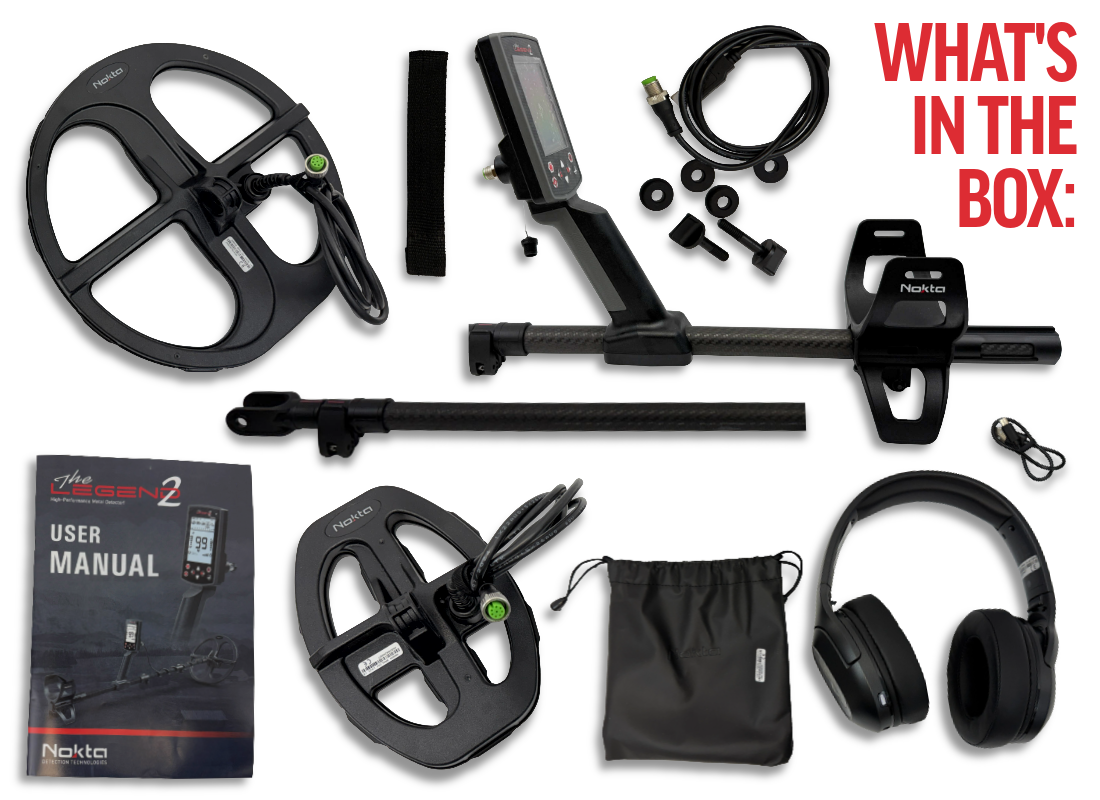
What's in the Box
Every Legend 2 ships with a complete detecting package:
- Legend 2 System Box — Redesigned interface, larger display, backlit keypad
- LD28 Waterproof DD Search Coil (11" / 28 cm) + Coil Cover — General purpose detecting and open ground
- LD21 Waterproof DD Search Coil (8" x 5.5" / 21 x 14 cm) + Coil Cover — Tight spots, trashy areas, and target-dense sites
- Bluetooth aptX™ Low Latency Headphones + Soft Case — Wireless audio with no perceptible lag
- USB Charging & Data Cable — For charging and wired firmware updates if preferred
Ready to hunt the day it arrives.
The Bottom Line
Nokta made a serious investment in the Legend 2, and it shows. This isn't a minor revision or a marketing play — it's a comprehensive rethink of a detector that was already outperforming its price class.
The expanded 99-point Target ID addresses the original's most commonly cited weakness. FerroCheck gives you an entirely new layer of information before you dig. The dedicated Relic Mode, redesigned audio, visible pinpoint ID, and quick access menu all respond directly to feedback from the detecting community. The hardware improvements — lighter build, bigger battery, wireless updates, new coil platform — reflect a commitment to building a detector that performs at a premium level and stays current over time.
Nokta has a track record of standing behind their products with meaningful firmware updates that improve performance long after the initial purchase. The original Legend received multiple updates over its life that added features and refined performance. With the Legend 2's wireless update capability, that kind of ongoing development becomes even easier to deliver — and easier for you to take advantage of.
The original Legend made history in the detecting world. The Legend 2 is built to help you find it.
Ready to see the Legend 2 for yourself? Check out the full specs, photos, and availability here at Kellyco.
Have questions about whether the Legend 2 is right for your style of detecting? Our team has been helping detectorists find the right equipment since 1955 — give us a call or stop by. We're always happy to talk shop.
Sources & Further Reading
Official Specs:
Reviews Referenced in This Article:
- Skill School — Nokta Legend 2 Review
- Mental Metal Detecting — Legend vs. Legend 2: Is It Worth Buying?
- iRate Metal Detectors — Nokta Legend Review
- metaldetectingworld.com — Nokta Legend Review
Want to Do Your Own Research? Here Are Some Popular Community Forums:
- DetectorProspector.com — Active community with detailed technical discussions and field reports
- Find's Treasure Forums (FindMall.com) — Long-running forum with dedicated Nokta threads and user settings comparisons
- TreasureNet.com — One of the largest detecting forums with brand-specific sub-forums
Related Reading from Kellyco:
- Introducing the Nokta Legend 2 — Our initial announcement and overview
- 2025 Ultimate Beginner's Guide to Metal Detecting — If you're new to the hobby, start here
- Metal Detecting Tips: Fine-Tuning Your Detector — Ground balance, frequency selection, and getting more depth
- Metal Detecting Civil War Relics — For those eyeing the new Relic Mode
- Beach Metal Detecting: The Complete Guide — Techniques for saltwater and surf hunting
- Minelab Equinox 600, 700, 800, and 900 Comparison — Deeper dive into the Equinox line